Showing posts with label Types of Shots. Show all posts

Thursday, September 1, 2011

Extreme Close Up: We’re Gonna Blow Up!!!

Extreme close ups are just that…close ups to the extreme!  You want to go extreme when the script is going extreme; when you want to emphasize the moment. 

That moment is usually due to one of these:
-Pain
-The moment before the decision is made
-Revelation

You also want to make sure this moment is important enough to warrant an extreme close up.  If you pull in this close when the main character has a paper cut, things will be a bit weird.  But if you pull in this close when the main character is shot, then all is good…well, not your main character who now has a bullet in him.

Like close ups, extreme close ups should also be used sparingly so not to loose their impact.

Objects:
Extreme close ups also have a functional use and this is when you need to see details on an object. Say if the bomb is ticking down, we won’t see those tiny numbers in a wide shot.  Even a close up won’t give us the full impact of the numbers ticking down. In a close up we’d see more of the bomb, maybe the wires and the casing.  With an extreme close up, all we’d see are the numbers. Nothing to distract us from the fact that our heroes are going to be blown up in 2 seconds! NO!!


The Wrap-Up
And that sums up shots and distance.  Here’s a quick overview for the forgetful:
  • Wide Shot:  Good for establishing shots that open the story or orientates the reader to a new environment.
  • Full Shot: Is all about the action and the character’s position in the setting.
  • Medium Shot: Good mix of background and characters.
  • Medium Close Up: Good mix of background and characters, with more focus on the characters.
  • Close Up: Is about the character.  Background will often not be shown or shown very minimally. Use sparingly in comics.
  • Extreme Close Up: Is all about the emotions.  Use sparingly in comics.  It’s also for important details on objects.

Wednesday, August 24, 2011

Close Up: P.U.!! Get a breath mint!


Close Ups are probably the best known shot and is the one we are drawn to the most.  This shot is all about the character, about getting into their space, feeling their emotions and smelling their bad breath. Backgrounds and other characters become secondary or non-existent.  This is the featured character’s moment. 


Distance wise, we are looking at shoulders and up or an equivalent shot of another body part....is anyone else’s mind in the gutter at this moment? 

With comics, close ups should be used sparingly.  They are your money shot on a page and you want to keep its impact.  If a page is full of close ups they start to loose their power, like when you hear a song over and over again.  It looses something each time.  If you rely heavily on close ups, you’ll end up having to push in closer and closer to re-find that emotion.  Eventually, you might end up with shot of the character’s DNA!

The same is somewhat true for films, but not as a strict rule.  Films have many more images to play with, more time to work with, and other ways to vary up a close up (sound, movement, actors acting).  It would be interesting to see if a short film could pull off telling a whole story with just close ups. 

Next: Extreme Close Up! 

Thursday, August 4, 2011

Medium Shot: Are You Looking at Me?

We’re getting closer now!  The camera is now starting to get into the character’s face.  Mean, evil camera.  We are on medium close up.  Now, as most of you smart readers can suss out, this is a shot between a medium shot and a close up shot (we’ll get to that next post).  Basically, this shot will be from about the chest up…or from the thighs down if you need to see what boots Hero Chick is wearing for some odd reason.  It’s pretty much 1/4th of your character in shot. 


Like a medium shot, it’s a good mix of character and background, though a medium close up will focus a bit more on the character.  We can really start to see the emotions in the face now.  It’s like having a one-on-one conversation with a person.  Staged any farther back and you’d have to be yelling to hear each other.  Staged any closer and you’d start to get into their personal space…which, depending on the situation could end with a bloody nose or a new human in 9 months.

You’ll see medium close ups used a lot in both films and comics.  It’s just a great every use shot. 

Wednesday, July 20, 2011

Medium Shot: Don’t Chop Me Off There!!!

Here we are, back with the different types of camera distances (sorry for the delay...vacation time and all that).  If you’re just joining us, feel free to see the previous post about wide shots and full shots.  Today we are on the every exciting medium shot. Ohhhhh Ahhhhh.  Wow.

Medium Shot: We have now moved close enough to the character so that part of him/her has been chopped off.  But don’t worry, it was a clean chop; no blood.  And to keep there from being no blood, you must never chop them off at a major joint.  If you do, it will look like you just amputated your characters and that’s not fun for anyone.

How close you are in medium shots can vary.  It’s usually far away enough that you see at least half of the character’s body if not more.  You use a medium shot when you need a good mix of background and characters.  We are now close enough that we can really see the character’s face, but we still get a good look at the background.  It’s your Swiss Army Knife of shots; has a bit of everything. While, like your knife, you might want to use this shot all the time, don’t.  Variety in shots will keep the audience interested.  Medium shot after medium shot will get old fast.

Next: Medium Close Up! 

Tuesday, June 21, 2011

Full Shots: Place and Action

We are back with camera distances and we have now moved our camera a good bit closer into a full shot.

Full shots show the full length of the character but are close enough so that we can see their details.  Their faces are no longer dots, their arms and legs are now more than squiggly lines…well, they might still be squiggly lines if you’re still working on your anatomy, but ideally they should be looking more like arms and legs now.  Bobby-Boy’s gun is also becoming more gun-like.

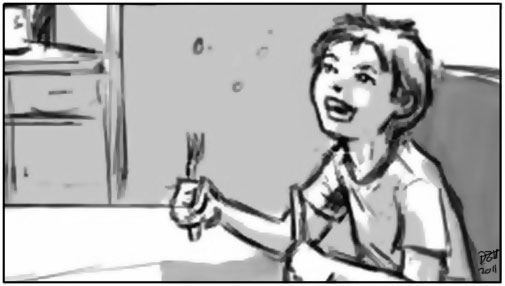
Full shots are about the characters’ action and their position in the scene.  Do you need to establish that Annoying-Kid is sitting at a table waiting for dinner?  A closer shot might not get that message across, but if you pull back a bit so that we can see him at the table and the mom preparing the dinner, then bingo, the audience gets the message. But pull back too far into a wide shot and it becomes more about the room and less about Annoying-Kid and his annoying body language. Body language is key in full shots.


Full shots also allow us to see more of the characters’ interaction with their environment. It’s not just about placement as it was with wide shots, but it’s about what they are doing in said environment.  Is Hero-Chick now hiding behind a box?  Is Bobby-Boy now strolling down the pathway? These could be full shots; place and action.

Next: Guess what…yes! Bobby-Boy took a breath mint so we can move closer!  It will be medium shot time! Yippee! 

Wednesday, June 15, 2011

Wide Shots and Bobby-Boy’s Gun

With all visual storytelling, the first question to ask yourself is: “Do I have enough munchies on hand?” (I suggest Hot Tamales, mmmmm Hot Tamales.) The second question is: “Where should the camera be?”  By camera, I mean either a-soon-to-be-real one with storyboards or a virtual one with comics.

This breaks down in the simplest terms of distance and angles (though some might call on angels to help too). 

Let’s look at distance first.
First, we have the farthest away shot called a wide shot where the camera is far, far away from the characters. It’s all about the place, the mood, the setting.  This is where you let the location speak. 

Wide shots are about the big details. If you need the audience to see that Bobby-Boy is holding a gun, don’t use a wide shot.  The gun will be a teeny-tiny widdle line that your audience will never know is a gun (unless that’s already been established earlier). But this shot is not about his gun, it’s about the location, and his location in the location. It’s about how close he is to our Hero Chick. Is she close enough to kick the gun out of his hand or far enough that she could dodge the bullet; or is she fully screwed and in that sweet spot that is making Bobby-Boy a very happy boy? It’s also about the environment, the creepy warehouse our characters are currently in.  Are there boxes Hero Chick can hide behind? Are things lurking behind those boxes? Will she get tetanus from the rusty, ugly nails that are sure to be littering the ground is this worn out, abandoned warehouse or is the warehouse so clean and modern that she might slip on the floor as she tries to run?


Often you’ll hear of an establishing shot.  This is usually a wide shot that is used as the first image of a story. This tells the audience where your lovely story is taking place.  It orientates them, grounds them in the world you are creating. It’s your tour guide greeting the tourist.

If what you need to convey in the shot is the location, location of your characters, the mood, or the big details, a wide shot is your friend. 

Please Won’t You Be My Neighbor
Keep in mind that shots cannot be thought of alone. They are social creatures. They like their neighbors; they like to know what their neighbors are doing.  Did wide shot’s neighbor to the left (assuming we are reading left to right) establish who the two figures in the warehouse of horrors already were? Or is wide shot the first house on the block and therefore these two tiny blobs of figures are a mystery to the audience?  Or is wide shot pissed off at his neighbor for mowing the damn lawn at 9am on a Saturday?

Next, we move a bit closer with full shots. Yahhhhh!